Book Event

I attended an event with Mysterious Galaxy Bookstore discussing The Jinn-Bot of Shantiport by Samit Basu.

First off, it was cute how much Samit loved the book that the interviewer Valerie Valdes wrote, which was Where Peace is Lost. After congratulating her and telling her it was amazing, he went on to explain that when the characters in her book first met, he knew the ending he wanted. And that meant a lot to him because it formed the central framing to where he questioned whether everything that was happening would affect what he wanted to happen at the end. I thought it was really cool that he took the time out of his interview to talk about her book that it was obvious he looked up to it.

When Samit was asked where he got the idea for his book, he explained that the idea had come from Aladdin. He felt that Aladdin was a fable that had no home and needed one and thought it had good relatability because it was known throughout the world. The biggest prompter for him to want to write his own story influenced by Aladdin was because he always had a problem with the original story. He didn’t like the wishes Aladdin made and didn’t like the character’s actions. He didn’t care for how Aladdin lied, stole, and cheated, and especially how he didn’t care about his city. He wanted all of that fixed. He wanted to see what would happen if Aladdin actually cared about where he came from, so he used the city where he grew up to inspire the city in the book.

To write a story, Samit explained he starts with a very complicated and detailed plan but is well aware that his plan will change. And that when it does, it means the book is talking back to him, and what he is doing is working. His novel is about a revolution where he wanted to use robots. He wanted to explore how robots could fit into society, their feelings, what drives them, and the bonds they make.

Apparently, what he did with the robots worked because he found them to be the most relatable as told by readers. Valerie added that she believes it is because it is a normal human impulse to side with the underdogs, which is what she was doing when she read it. She expressed multiple times how much she loved the robots.

Samit has some NDAs, but he did say he is waiting for a few things to fall into place regarding his writing and career. Valerie said that she is planning a sequel to her book, Where Peace is Lost. She is just waiting to see how many people buy that first book first.

The discussion between these two, especially their in-depth talk about robots across genres and media, was heartwarming. Thank you, Mysterious Galaxy, for the great event.

Book Event

I was able to attend an event hosted by Oxford Exchange Bookstore discussing the book Mexican Gothic by Silvia Moreno-Garcia.

This was a fun discussion with lots of laughs that went into how gothic books are typically written because many people in the group read the gothic genre. I was unaware that gothics typically are very slow-paced to let gloom seep in slowly. This was brought up because many reviews complained about the pacing.

I loved how much was researched about this book by the other members. I didn’t know that there were so many things that were based on real people and places in this story.

We went through examples of how this story commented on colonialism. Like them bringing their own soil to where they were to take over. (If anyone has read this, they should hopefully know what that means).

 Everyone liked Naomi. The best compliments she received were that she was fun and unapologetically her. Also, that she was inspiring in how she fought for control in a part of history where there wasn’t much control for women in their life.

Everyone absolutely loved the imagery and were amazed at how the author could write disgusting things so beautifully that made readers entranced by her words yet feel icky inside. It was funny because during the meeting, we looked up if this book would be turned into a movie because everyone agreed it would be excellent for film. We found that Hulu bought the rights a long time ago to turn it into a series, but no one has heard anything about it since then.

Near the end of this event, it definitely showed how great this book is for discussion. It felt like a Nancy Drew game, with everyone trying to piece things together and laughing the entire time.

Thank you, Oxford Exchange, for this event.

Book Event

Today we discussed Juniper & Thorn by Ava Reid with Oxford Exchange Book Club. It seriously was a fun discussion. This book opened up many readers to discuss things we usually wouldn’t have discussed. We learned so much about each other and saw everyone light up with their passions.

But honestly, all I am going to say about this book, from my perspective, is that it is very triggering. The best way I can describe how triggering is by saying that if I were younger and had gotten ahold of this book when I was not mentally stable, I would have unalived myself because of the ending.

Below is a spoiler.

In this book, the main character, a victim of multiple forms of abuse, turns into a monster at the end and kills people. For me, that is the worst nightmare for many victims of abuse. Many young kids grow up scared to death that they will turn into the monsters that feed off of them. They demonize themselves. They humanize and make excuses for everyone else. Then at the end, this is what happens with the main character. She ‘has the seed of her papa’s monster living inside her,’ which was too much for me.

I love dark stories. I need them. But I also appreciate it when people are careful. Alice by Christine Henry is a book on this theme that does this amazingly, with still many trigger warnings. She demonizes the abusers by making them creatures. She gives strength to the abused. She uses tactics to put the perfect distance between the reader and the story while still offering the reader the glorious wave of darkness they can relate to and are looking for.

I would recommend Alice all day for those who love the dark sides of things. This one, not so much to those who have been abused. To those I would say to be extra careful.

Book Event

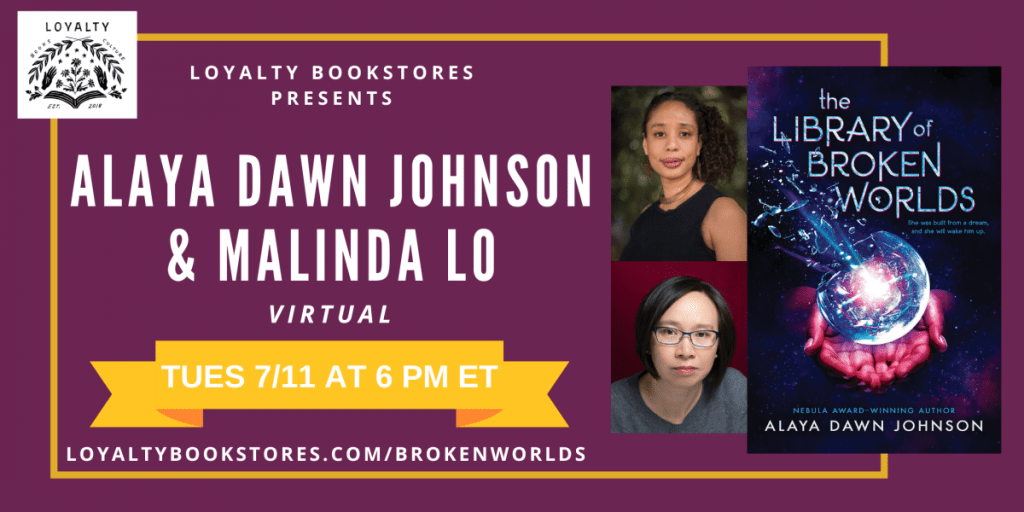
Loyalty Books hosted an event to discuss The Library of Broken Worlds by Alaya Dawn Johnson.

I loved listening to Alaya. She was very intelligent and insightful when it came to humanity and perspectives. She also put much care into her book to ensure certain characters came across as she wanted, along with certain social situations, contrasts, environments, and how the cities and her world would function. I could tell she cares so much. She said she rewrote four-fifths of the book, and the character Joshua was the big reason for the rewrite because she wanted to get him right.

Malinda Lo asked Alaya to describe her book since, most of the time, how an author would describe their book is different from how it is defined on the back cover. She started by saying, “This may not seem commercial.” Haha, but how she described her novel sold it to me, even though I have already bought it.

To Alaya, her book is a big idea of far-future sci-fi, like a new wave of sci-fi, with big social ideas about a young woman born in a place called a library, which was founded in the aftermath of a war. In the library, there are four gods that are giant AIs. Her world has eight gods in total, four of which are in the library. The main character is considered something between a human and an AI because she was born in the library. Through her relationships, the main character discovers the library’s history and what it means to be her.

Malinda Lo added to describe the book as a vast, complex, multi-layered world that blows her away.

Malinda Lo asked where Alaya’s idea came from. Alaya said her idea started with a basic concept while she was in the shower of a woman crossing a desert, leaving a library she didn’t want to leave, and heading toward a god that wanted to kill her. She also knew that the image she had in her head was sci-fi, not fantasy.

Alaya then went on to explain that world-building was very important to her in this story. She wanted the world to feel lived in, and like it could exist but to give a certain experience to it. She wanted to figure out how an organized society would work where people could download themselves or back themselves up. Or how a world would work where giant AIs can store so much knowledge. When she was writing and world-building, she felt like she was discovering her world, like she was chipping away at it and revealing it.

Book Event

I was able to attend a book discussion hosted by Oxford Exchange Bookstore, discussing the book Nettle & Bone by T. Kingfisher. It was a very insightful conversation!

We first opened the discussion with what kinds of fairy tales we saw in this story. A few that were named were “Sleeping Beauty,” “Cinderella,” “Pinocchio,” and loosely “Wizard of Oz,” “Alice in Wonderland,” and “Rumpelstiltskin.” Everyone thought that this was a story that lived adjacent to fairy tales and in conversation with fairy tales instead of any kind of retelling.

Just about everyone in this group loved this book for a variety of reasons. One was the spaced-out surprising humor. Another was the Blistered Land, which everyone wanted to see more of. Many liked how refreshing it was that the main character was older and in her thirties. They forgave her for being as weepy as she was because of how sheltered she was growing up. And everyone loved the side characters, especially the dust-witch.

It was very interesting to hear that a majority of people believed that it was the land that gave the main character the magick to make the bone dog, which I agree with and was not something I had thought of. Another interesting topic that was discussed in this conversation was feminism and how many couldn’t wrap their minds around this being a feminist book, especially since it still had such misogynistic requirements.

This book brought up many conversations about life, literature, prose, history, and other forms of media. One of the questions that it also brought up that still lingers in my mind is what is more fairytale-like, someone having to partake in a tortuous punishment for the rest of their lives or someone just dropping dead?

Book Event

This is a small post about the event I attended with Oxford Exchange Bookstore for The Empress of Salt and Fortune by Nghi Vo. Since the book is a novella, I thought a small post would do.

For me personally, this book wasn’t for me, but I was very busy at the time to be able to go into the metaphoric writing that this had. So, I wanted to listen in and get the other side of things.

What I learned was that this book is for people who love puzzles and deciphering things. A whole other brand of brilliant minds that do not link up to my own. I was told that this book was about “remembering the small moments and how sorrows, tragedies, and anger can fuel people.” For many, this novella was very subtle and refreshing. For others, they wanted more from it and felt like it glossed over too many things. It was an interesting book that was short and sweet. So, it was nice because I did not feel like I had wasted my time when I tried reading it.

Book Event

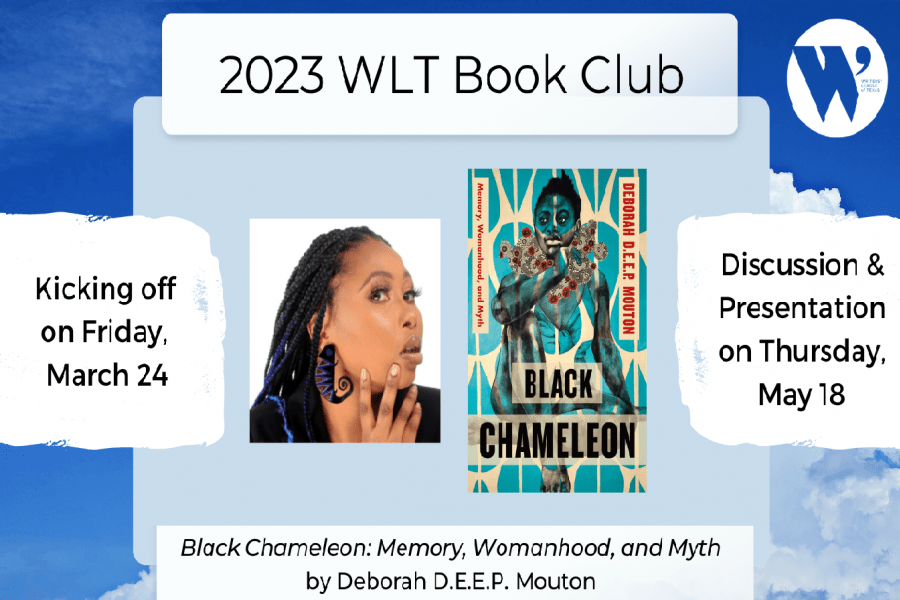
I was able to attend an event with Writer’s League of Texas discussing Black Chameleon: Memory, Womanhood, and Myth by Deborah D.E.E.P. Mouton.

Black Chameleon is Deborah’s first memoir. She expressed how for so long she lived in stanzas and lines being a poet first. With this memoir, she was trying to figure out how to hold integrity on the page. She realized in her life that things don’t translate to a page and so she wanted to see where poetry enters and exits in prose.

She explained how she had started collecting stories of her life for almost a year but found that something wasn’t working. She began thinking about the mythology of Black American women and questioning what her origin would be. She expressed how she felt African mythology didn’t explain her and how the American context didn’t feel right. So, diving into and creating mythology was a space for her to explain, give context, and figure out how she and her family became who they are. After she wrote her first myth, she finally felt seen.

She tapped into culture and reframed it into herself, which brought her joy. She gave what her people needed, mythology for themselves, to explain why they are who they are, while implementing Black and South culture.

It was very interesting and insightful to hear her explain how she wanted to feel intentional with her existence, instead of a byproduct of someone stealing her from her home and bringing her people to new lands.

Her goal was to immortalize herself in a tale. Create stories that never die. Give herself over to a tradition that will never be forgotten since she knows her people always feel like a forgotten people. She needed a space of belonging to work side by side with her memories. A new understanding of who she was in this world. And so, she created it.

Book Event

This evening I was able to attend an event with Oxford Exchange Bookstore discussing The Book Eaters by Sunyi Dean.

Everyone liked how the main character was a very real person who had flaws, especially when it came to her being a mom and trying her best. One of the best and cutest parts people found about the book was the motherhood parts. Even the readers who don’t normally care for books revolving around motherhood. They loved how and where she gave birth to her son. The remarks and things said between her and her son. And how the main character, as a mother, was represented in a very human way.

Everyone loved how the story was structured, with the past and present meeting at the perfect place and clippings of real-world and fantasy-world quotes and articles at the beginning of the chapters. They felt it helped enhance the story and blend the world.

One of the biggest discussions was how in this book, they didn’t just talk about books. They also talked about video games, which brought a nice familiar aspect that lent coziness to the story.

A character everyone loved was Jarrow. They also loved how his asexuality was presented and actually recognized. It was amazing how the brother believed his sexuality compared to a lot of media and tropes where asexuality is unbelieved.

This book seemed like such a great book for bibliophiles and booksellers with all the descriptions on how certain books taste. It led us to discuss what kind of books we would eat and what they may taste like. We were thinking for horror, a thick, inky taste like blood.

This book and author both seem to have gone through many challenges. It sounds highly frustrating that so many parts of the book had to be taken out, including how it was supposed to be set in different countries. Also, how it was supposed to be a series but got condensed into one. Because of this, it left some parts feeling unfinished to some readers, while others found it fine. But I feel that the author is inspirational for tearing this book apart and still telling a decent, well-characterized story.

Book Event

I joined Brookline Booksmith last night to discuss Fonda Lee’s newest book Untethered Sky.

For anyone who doesn’t know, Fonda Lee is known for her The Green Bone Saga series. She said that with this newest book, which is a novella, she had to use different brain muscles since she decided to take a step back from an epic world and story and dive into something else. She did this because she realized that trying to live up to what she did before was paralyzing.

In this newest book, she focuses on a single person instead of a large cast. She also made it pre-modern, added animals, and made it smaller in length to give her a clean break into something new.

Come to find out, this book started as a novel but then turned into a novella because someone asked her if she would be interested in writing a novella. Taking it into novella form helped her put pieces together that weren’t working as a novel. Then the story came to life.

During this process, she learned that a novella isn’t less in terms of worldbuilding work. She built an entire world for this small story and expressed how the temptation to write more stories in the world is there, but she only envisioned this world as the one story and doesn’t have another to tell.

What she found most challenging when writing this story was writing it in first-person instead of third-person. She wrote the first chapter from both points of view and then sent it out for validation to see which was better. She then went into length about how writing in first-person is different. How she could only know the character as well as they knew themselves and how it was a different kind of intimacy compared to having multiple povs and being in third-person, where she could flesh out a character more with interactions and dynamics between other characters.

Another struggle for her was the story’s pacing being a personal journey versus an epic.

Last fun fact, Lee has been obsessed with falconry for the longest time. She knew it was something she would never be able to do, so she decided to write about it but add mythic possibilities to the sport. This is what makes up a core piece of this newest book.

Book Event

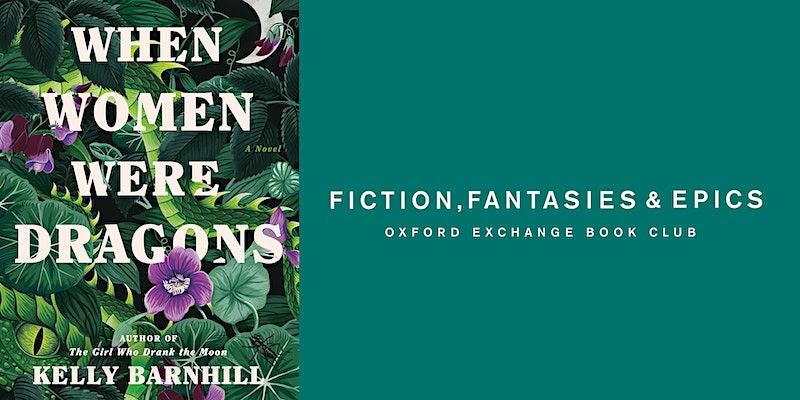
I had the chance to attend an enlightening book event with Oxford Exchange discussing When Women Were Dragons by Kelly Barnhill.

The reason why this event was so enlightening was because we had readers from many generations attend. It was great to hear their point of view and experiences that shaped how they viewed and read this book. This discussion got so personal and deep that I found myself wanting to sit in front of a fire with a coffee to continue talking through the night.

What was incredibly interesting was the fact that some readers liked the beginning of the book better than the end and some liked the end better than the beginning. There were also some who enjoyed the beginning and the end. The ones who liked the beginning liked that the women were angry. The ones who liked the end liked how the women had chilled out and became ok with who they were. A reader who lived in the 1950s, where this book was placed, said that she did not relate to the beginning because when she was living in that time period, the women she knew displayed their anger through depression. It was when those women started protesting that they found empowerment.

What I took away from this discussion that amazed me was what each reader lingered on in the story and how what they lingered on had them interpreting the story. You had some hold onto the anger. Some look for hope and see hope throughout. And some that saw rising to a challenge. There were also others that saw all of those areas and were able to take it all in.

When it came to the transitioning of the book and how the dragons went from what some readers viewed as fierce to then dragons with lipstick, purses, and other things, there were some who disliked that and others who loved it. The ones who loved it thought it was cute and saw it in a way that the women could pick up their femininity again they were throwing away and be them. The ones who weren’t a fan felt that it took them as readers out of the story making them unable to grasp what exactly the dragons looked like.

Everyone loved so many quotes from this book. Everyone also loved how well the author did in holding the headspace of a child for so long. The articles of the alternate history throughout were also a favorite for most of the readers.

This was a great book that held great protentional when it came to discussing issues through the generations.