I joined Brookline Booksmith last night to discuss Fonda Lee’s newest book Untethered Sky.
For anyone who doesn’t know, Fonda Lee is known for her The Green Bone Saga series. She said that with this newest book, which is a novella, she had to use different brain muscles since she decided to take a step back from an epic world and story and dive into something else. She did this because she realized that trying to live up to what she did before was paralyzing.
In this newest book, she focuses on a single person instead of a large cast. She also made it pre-modern, added animals, and made it smaller in length to give her a clean break into something new.
Come to find out, this book started as a novel but then turned into a novella because someone asked her if she would be interested in writing a novella. Taking it into novella form helped her put pieces together that weren’t working as a novel. Then the story came to life.
During this process, she learned that a novella isn’t less in terms of worldbuilding work. She built an entire world for this small story and expressed how the temptation to write more stories in the world is there, but she only envisioned this world as the one story and doesn’t have another to tell.
What she found most challenging when writing this story was writing it in first-person instead of third-person. She wrote the first chapter from both points of view and then sent it out for validation to see which was better. She then went into length about how writing in first-person is different. How she could only know the character as well as they knew themselves and how it was a different kind of intimacy compared to having multiple povs and being in third-person, where she could flesh out a character more with interactions and dynamics between other characters.
Another struggle for her was the story’s pacing being a personal journey versus an epic.
Last fun fact, Lee has been obsessed with falconry for the longest time. She knew it was something she would never be able to do, so she decided to write about it but add mythic possibilities to the sport. This is what makes up a core piece of this newest book.
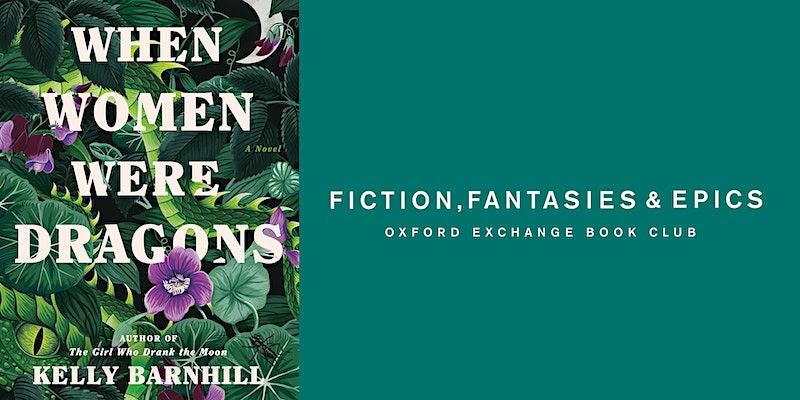
I had the chance to attend an enlightening book event with Oxford Exchange discussing When Women Were Dragons by Kelly Barnhill.
The reason why this event was so enlightening was because we had readers from many generations attend. It was great to hear their point of view and experiences that shaped how they viewed and read this book. This discussion got so personal and deep that I found myself wanting to sit in front of a fire with a coffee to continue talking through the night.
What was incredibly interesting was the fact that some readers liked the beginning of the book better than the end and some liked the end better than the beginning. There were also some who enjoyed the beginning and the end. The ones who liked the beginning liked that the women were angry. The ones who liked the end liked how the women had chilled out and became ok with who they were. A reader who lived in the 1950s, where this book was placed, said that she did not relate to the beginning because when she was living in that time period, the women she knew displayed their anger through depression. It was when those women started protesting that they found empowerment.
What I took away from this discussion that amazed me was what each reader lingered on in the story and how what they lingered on had them interpreting the story. You had some hold onto the anger. Some look for hope and see hope throughout. And some that saw rising to a challenge. There were also others that saw all of those areas and were able to take it all in.
When it came to the transitioning of the book and how the dragons went from what some readers viewed as fierce to then dragons with lipstick, purses, and other things, there were some who disliked that and others who loved it. The ones who loved it thought it was cute and saw it in a way that the women could pick up their femininity again they were throwing away and be them. The ones who weren’t a fan felt that it took them as readers out of the story making them unable to grasp what exactly the dragons looked like.
Everyone loved so many quotes from this book. Everyone also loved how well the author did in holding the headspace of a child for so long. The articles of the alternate history throughout were also a favorite for most of the readers.
This was a great book that held great protentional when it came to discussing issues through the generations.
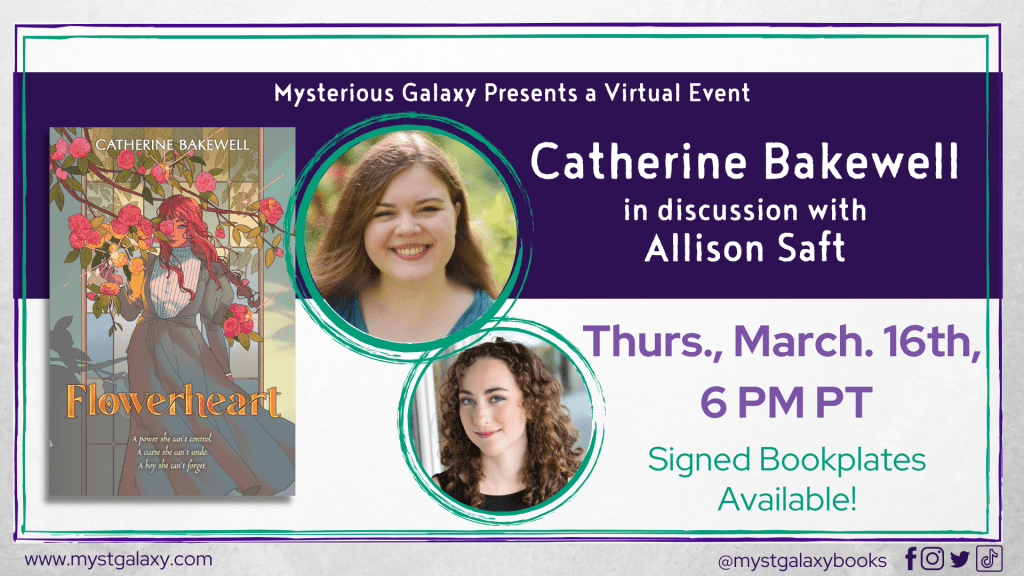
I got to attend an event hosted by Mysterious Galaxy Bookstore for a discussion about Flowerheart by Catherine Bakewell, between Catherine and Allison Saft.
Catherine Bakewell was the sweetest! Her and Allison have been friends for about six years. It was cute to see that Allison was so excited to share this moment with her friend. They apparently met over a pitching event. Catherine contacted Allison because she thought her pitch was awesome and then they became query buddies. They announced that they decided the main character in Flowerheart and one of the characters in one of Allison Saft’s books are cousins. Haha.
The host showed some awesome character art that Catherine’s friends made. One piece of art was made by her friend when her friend read her manuscript four years ago. She had called her up and was like, “Now is the time!”
Catherine’s book is a cottagecore YA Fantasy Romance. Cottage core is light-hearted, summery, and takes place in country side. It is a cozy fantasy. In her book, her main character Clara makes flowers grow because of her emotions. She accidently curses her father, making flowers grow in his lungs. She then has to team up with her best friend who is hiding secrets and they have to make a hard bargain. It is apparently full of feelings.
In the book she uses concepts of flowers that she learned from Nancy Drew computer games that stuck in her mind. The name Xavier is also from Nancy Drew!
Catherine started the book in 2017 and wanted to make it a fun and bright world. It is different from the first version of the book drastically, but she still kept it fun and lovely. Some of the things that had changed from the beginning was the age of the characters. When she started, she considered the book adult and had the characters 22-years-old. But then she was told it was YA, so she made them 18, then 17, and then the editor had her make them 16. Also, the two main characters Clara and Xavier didn’t know each other at first. To solve the problem of them falling in love in 9 days, she made them childhood best friends.
I loved when she talked about her listening to her audio book version. She said it was like watching a movie in her head that she has watched at one minute increments for many years. She said it is like listening to her children. She loves being able to go on the journey with her characters again in a cinematic form.
She considers this a very therapeutic book. It has lessons she had learned from therapy in the book that the characters puts into practice.
What a great discussion about Deep by Rivers Solomon with Oxford Exchange Bookstore.
At the beginning, everyone agreed they felt a little lost but that the book was most likely made that way to fit the story. Everyone also agreed that the world was beautiful, immersive, and enticing enough that even though confusing, they wanted to stay and keep going. They also wanted to follow the main character’s stakes because they were personal enough to cling to and care about.
It was interesting to hear that many reviewers thought that Yetu seemed whiny. Everyone jumped to defend her in the group, believing that she wasn’t whiny and that, even if she was, she had excellent reason to be. She was being tortured in a very real sense by how she had to live.
Everyone discussed the bits and pieces that described how the mermaids looked and then went further into how they might have sounded. There were so many favorite quotes, moments, and scenes in this book that everyone stated. So many wished that the book could have gone on longer.
On the discussion with it lasting longer, it was brought up that maybe the book was the short length it was with nonreaders in mind so that they would have an easier time digesting the topic, and so it would welcome them into the reading world. I thought that was an excellent take.
Everyone loved this book and thought it had a great premise when it came to giving back to the lives that were stolen and giving people that were killed a history by becoming something else that was everlasting.
I got to attend a book event with Brookline Booksmith for the new book coming out TheAdventure Zone: The Eleventh Hour which is the fifth graphic novel to release in the series. Clint McElroy, Griffin McElroy, Justin McElroy, Travis McElroy, and Carey Pietsch discussed it with a few special guests.
If you are wondering, they are mostly all a family. Three brothers, a dad, and Carey the cartoonist. For some of them, it was the first time they met the cartoonist, so it was cute to see them so excited to meet her. And even cuter that the dad was dressed in a chainmail cosplay.
They asked her which picture the cartoonist drew where she really blew it haha. She said something about a time-loop page.
They discussed how they really started taking it seriously with this book and put a lot of work into it and that it’s their best one yet.
They had special guests who said there were tons of cosplayers from Monty Python and the Holy Grail everywhere during release day at their bookstore. All of them, including the special guests, did a reading for each character. The colors and pictures of the graphic novel were brilliant. It was cute and funny with cuss words haha.
They also had their editor on to discuss things too.
This was a dynamic team with funny reactions and conversations between everyone. They definitely all have fun.
Carey showed them pictures of her trying out Blender 3D. The beginning pictures were hilarious from when she started the system, then later turned very magical. Seriously, it was amazing how she made interiors of buildings, settings, and references for drawings because, how she described it, she doesn’t have a lot of RAM space in her mind. The best part was seeing Carey’s sketches and everyone trying to guess which panel they were from.
What an amazing team, all of them. And the fact that they all got together to talk about the process was amazing. Like seriously! Wow!
What a delightful book event with Oxford Exchange Bookstore about Spells for Forgetting by Adrienne Young.
It was interesting how such a simple book could bring about so many different layers of conversations. One of the layers we went into was the authenticity of a towns and how the author captured that in many areas. Some of the areas she captured that were when it came to tourists, the orchard, relationships, meetings, and the want for things to stay the same.
One of the ways that things in the real world may stay the same when it comes to small towns, like it did in this book, is when someone is around the people they grew up with and then fall back into that mindset. Which may be a younger aged mindset. Then comes the question of if you grow up with those people all around you, do you still fall into that mindset sometimes, do you ever really grow up, or do you need space in order for nostalgia to grasp you and turn you young again?
Everyone agreed that this book was a dark cozy mystery, like a campfire story. And everyone loved the vibes. Many expected more magic and kept trying to find it within the pages, while others enjoyed the light magic and undercurrent of it, saying that it felt more real that way.
I feel like the most interesting conversation that was had was about how to differentiate YA versus Adult fiction. Many agreed that this book felt like a YA read, but it was a YA author’s first Adult novel. Was the YA-like-feel in the way the book was plotted out and in how the author held the hands of the readers through the mystery? Or was it because it was in the minds of characters who were reliving the past, a period when they were teens? Or was it because of the pacing, the themes or lack thereof, the topics, or the relationships? What makes an adult read an adult read, besides the main character in the present timeline’s age?
All very interesting questions worth hours long of conversation.
Books are Magic hosted an event with Camryn Garrett about her book Friday I’m in Love.
The author came dressed in a dress similar to the main character on the book cover! So that was cool! Friday I’m in Love is about a girl who decides to have a coming out party to announce her queerness to her friends and family. Friday I’m in Love is Camryn’s third novel, but first rom-com. She grew up writing lots of ghost stories and wrote this book in high school when she was eighteen. According to the interviewer, she really captured the teenager spirit in this book and it only took the interviewer under 24 hours to finish the book because she loved it so much.
The idea came to Camryn Garrett when she thought about how her friends would have thrown her a party if she had come out when she was younger. She wanted to express that you don’t need to know who you are at sixteen. She explained that parties during milestones like coming of age and sweet sixteen parties are important because it shows that the people who are there care for you, so she wishes there were coming out parties also.
They talked about the music mentioned in the book, social classes in real life and in books, also how different it is writing screenplays compared to books.
Here are some cute, fun, and funny facts from the interview. According to Camryn’s mom, all the characters in Friday I’m in Love are Camryn. Haha. One of Camryn’s favorite tropes is enemies to lovers, but with low stakes. No ‘you killed my brother or you tried to kill me’ “because that’s just wrong”. Haha. Her least favorite trope is second chance lovers because, most likely, if you didn’t work out the first time, you shouldn’t try again. Haha.
This interview was a fun, lighthearted, and uplifting. Thank you, Books are Magic for hosting it.
All The White Spaces by Ally Wilkes was a book to have an interesting conversation about.
The vibe everyone got from the book was gothic-ship/ gothic-Antarctica because there was such emotional trauma and desperation coming from those places displayed atmospherically.
Most of the people in the book club loved the book, but a lot of Goodreads reviews were not a fan of what everyone in discussion loved about it.
Below, when I say “others” I am mainly talking about reviewers and the smallest amount of people in the book club.
Some found it not slow-paced at all, while others found it too technical and too slow. Some found it didn’t present the LGBTQIA+ community enough because of the technicalities being in some areas while not in others, while others thought that the emotional social aspects of the story and the journey did. Some found it scary, others didn’t. Some liked the balance of suspenseful events, others wanted more.
Definitely conflicting opinions with this one. I think after listening in depth to readers it comes down to whether a reader likes a character-driven-slow-burn book or not.
Loyalty Bookstore threw an awesome jerk-free event for the book Weightless by Evette Dionne interviewed by Aubrey Gordon. I found it absolutely insightful and fascinating.
First off, they explained how to them the word fat is just a descriptor. It is not a bad word. Not a judgment. But people should use the language that others use for themselves. It is only respectful to meet someone where they are at.
Aubrey Gordon gave an amazing testimony to the book, explaining how it is a book for fat people to be able to see more fat experiences and for others to understand. She said it has a variety of fat experiences and that the book has incredible complexity and vulnerability woven together. It choked her up several time and also made her laugh out loud many other times. She said it was one of the most honest and moving pieces she has ever read about fatness.
Evette Dionne explained that one of the best parts of her childhood was her very supporting parents that did not force her into dieting. Her parents advocated for her relentlessly and were committed to her being a kid. They didn’t want anything to steal her joy. But even with her parents being like that, her mother still dieted.
One of the topics of this conversation was Weight Watchers. Evette talked about how when she was 22 and was in grad school on a full-ride scholarship, she was depressed. She didn’t recognize that it had to do with her mental health though and not her weight, so she started going to Weight Watchers. She explained how very conscious she was about how heavy her clothes were at the time of meetings and how she would not eat too much on the day of weigh in. Aubrey commented on this section of the book saying how real it all felt, because she had been there too. Evette realized that going to Weight Watchers was bad for herself when she was in therapy. She questioned why she was doing something she dreaded that didn’t make her happy and only more depressed. It was supposed to be helping her fight depression, not the other way around.
Other topics that are in this book are dating as a fat person and forming a relationship with another plus-sized person. Also, how life as a fat person is always influenced by strangers and family member’s off-handed comments.
Interesting topics they brought up in conversation were ways they notice anti-fatness in themselves and how they are working on getting rid of it. Evette grew up surrounded by fat people her whole life and she says she still passes judgment while watching TV. She said that her journey is an unlearning journey, not a perfect journey. Even now, how she thinks about and treats her own body is bad. If her partner catches her, he goes “I know you aren’t talking about MY partner!” She was very honest about how hard on herself she is even in this part of her journey. That she is working on being present in her body. And working to continue to grow.
They dove in deep about movies and media. They said that there are slim pickings when it comes to good media representation. They recognize that representation isn’t everything, but it is something. If represented well, it can help watchers realize they are not being treated right.
The movie that just came out called The Whale, they talked about it having maybe only one fat person who is critic, if that. How is the movie authentic if not fat people are judging it on its merit? All critics are doing are looking at how great the acting is and pushing away all the social issues because it is Brandon Fraser’s come back. They even mentioned how it lost the plot once a fat suit was introduced.
They see body positivity as being useful in terms of going to the store and buying clothes and being able to see things that make them feel great on an emotional level. But that it is only being used to help sell things. There is no movement to actually break and fix the system. They want people to be trying to find a functional way to look at roots to see what is causing fat-phobia and what is actually working when it comes to body positivity and what is not.
The healthcare system was another interesting hard topic. How a thin person can go into a doctor and get a diagnosis right away, instead of the doctor trying to treat the patient’s weight and not really what is wrong.
Evette’s brother is thinner and they worked and worked and worked until they figured out what was wrong with him. Which was heart problems. Evette had to almost die for them to realize what was wrong with her heart.
Through this, they expressed how anti-fat issues within the medical field can do a lot of harm.
Aubrey and Evette talking to each other was very uplifting and cute. I loved the very memorable things they said and their discussions. Like the saying: what makes you resilient can also break your heart and how we live in a world where thin people are seen as experts on fatness.
I found this event very insightful. I cannot wait to read the book when it comes in. This event also had me reading an article Evette Dionne wrote awhile ago called The Fragility of Body Positivity.
The link to the article is below if anyone is interested in reading it.
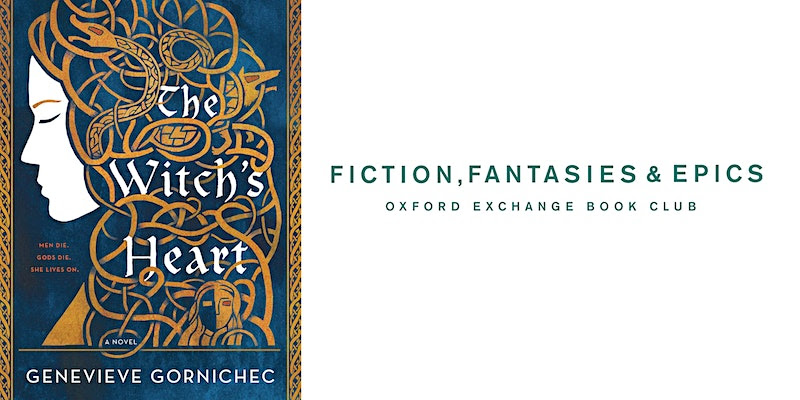
Oxford Exchange Bookstore hosted an event to talk about The Witch’s Heart by Genevieve Gornichec. It was great seeing what worked for everyone and what things other readers knew about the author and this book after researching.
Everyone loved the snake in the story! All the way from when the snake was a baby to when he was a giant adult snake. Everyone liked the visions, especially in Loki’s point of view. And everyone, of course, liked how the author portrayed Loki. She did an excellent job.
One of the most interesting things about this conversation was how much Marvel influenced everyone’s reading. Everyone imagined Loki the same way because of the movies. We also had a hard time splitting the real mythology from the cinematic mythology that Marvel has brought us. Many didn’t know what Hel looked like in the actual mythology stories and were confused at how she was related to Loki because of the movies. Same with Odin and other characters.
A couple interesting facts that readers pulled from research was that the author combined three different stories to make the main character. Also, that back in time, the heart was seen as something that held memories instead of the brain, and that may be why the heart was represented the way it was in the book.
Jumping back to Loki. This book was marketed as a sapphic book. It was not a sapphic book, or if it was, it gave very little to the relationship that could have been defined as sapphic. But in our conversation, we thought it was interesting that the author went the way she did about it, by not ever really letting Angrboda and Skadi be together, when we thought that Loki would have been more than ok with her being with Skadi and himself, especially since he was doing the same.
Another interesting thing for readers who have not read the book, the book is structured with no chapter breaks. There are only three parts. The first part is about half of the book. For some readers, this bothered them, but for others, especially if listening on an audiobook, it didn’t bother at all.
Very thankful for the awesome conversation and for Oxford Exchange hosting this event.




 Regaining Lost Aspects: Mind and Soul